Summary below is a compilation of my notes I wrote when reading Materialism and the Dialectical Method by Maurice Cornforth, along with general knowledge from reading various Marxist authors.
Often times, Marxists use the term “material conditions,” and “dialectics.” What does this mean? Why do Marxists care so much about material conditions? The answer is that Marxists seek materialist explanations for observed processes as opposed to idealist, and do so dialectically, as opposed to metaphysically. In other words, Marxists apply dialectical analysis to find materialist explanations for phenomena. Dialectical materialism is the world outlook of the proletariat as a class, and serves as the most vital ideological tool for overthrowing capitalism.
In order to understand dialectical materialism, we need to understand its component parts, materialism and dialectics, and their historical predecessors, idealism and metaphysics.
Idealism

Idealism is, in short, to put ideas prior to matter. Idealism has been used by feudal lords to justify their position above the serfs, forming the ideological basis for feudalism. The 3 major assertions of idealism are as follows:
-
Idealism asserts that the material world is dependent on the spiritual
-
Idealism asserts that spirit, or mind, or idea, can and does exist in separation from matter. (The most extreme form of this assertion is subjective idealism, which asserts that matter does not exist at all but is pure illusion.)
-
Idealism asserts that there exists a realm of the mysterious and unknowable, “above,” or “beyond,” or “behind” what can be ascertained and known by perception, experience, and science.
Early Materialism

Common idealist arguments are appealing to a supernatural “human nature,” or “good vs. evil” explanations for processes. Materialism arose over time, as people grew to understand the world more deeply, and especially as a tool to overthrow the feudal aristocracy that justified its existence via the church. In other words, materialism rose to help the bourgeoisie. The 3 basic teachings of materialism as counterposed to idealism are:
-
Materialism teaches that the world is by its very nature material, that everything which exists comes into being on the basis of material causes, arises and develops in accordance with the laws of motion of matter.
-
Materialism teaches that matter is objective reality existing outside and independent of the mind; and that far from the mental existing in separation from the material, everything mental or spiritual is a product of material processes.
-
Materialism teaches that the world and its laws are fully knowable, and that while much may not be known there is nothing which is by nature unknowable.
Shortcomings of Metaphysical Materialism

The type of materialism that overthrew the feudal lords was still underdeveloped, and metaphysical. The bourgeoisie needed an explanation for why the feudal lords were illegitimate, but still needed to support their own static, permanent rule. This was called mechanistic materialism, for the bourgeois scientists saw the world as a grand machine repeating simple motions forever. Mechanistic materialism, therefore, makes certain dogmatic assumptions:
-
That the world consists of permanent and stable things or particles, with definite, fixed properties;
-
That the particles of matter are by nature inert and no change ever happens except by the action of some external cause;
-
That all motion, all change can be reduced to the mechanical interaction of the separate particles of matter;
-
That each particle has its own fixed nature independent of everything else, and that the relationships between separate things are merely external relationships.
Moving from Metaphysics to Dialectics

This, of course, has proven false. History did not end with the dissolution of the USSR, despite what modern mechanistic materialists claim. Mechanistic materialism relies on metaphysics, seeing everything as a static abstraction, devoid of its context. It has no explanation for how new qualities emerge, and ultimately fell to idealism to explain the “first mover,” ie “God.” Dialectical materialism holds instead:
-
The world is not a complex of things but of processes;
-
That matter is inseperable from motion;
-
That the motion of matter comprehends an infinite diversity of forms which arise one from another and pass into one another;
-
That things exist not as separate individual units but in essential relation and interconnection.
Dialectical Materialism

This became remarkable for the proletariat, as it sees nothing as static, and therefore marks the eventual downfall of the bourgeoisie. Putting it all together, we get the following:
- Dialectical materialism understands the world, not as a complex of ready-made things, but as a complex of processes, in which all things go through an uninterrupted change of coming into being and passing away.
In other words, when analyzing events and contextualizing them, we must always viee them as a struggle between the rising and the falling, the old and the new, for example the concentration of capital in markets and the rise in socialize labor.

- Dialectical materialism considers that matter is always in motion, that motion is the mode of existence of matter, so that there can no more be matter without motion than motion without matter. Motion does not have to be impressed upon matter by some outside force, but above all it is necessary to look for the inner impulses of development, the self-motion, inherent in all processes.
In other words, all movement is a result of contradiction. Your foot presses on the Earth, and the Earth presses back on you.

- Dialectical materialism understands the motion of matter as comprehending all changes and processes in the universe, from mere changes of place right to thinking. It recognizes, therefore, the infinite diversity of the forms of motion of matter from the simple to the complex, from the lower to the higher.
In other words, dialectical materialism recognizes that development exists as a change of quantity into quality. Addition or subtraction gives way to qualitative change. A balloon is filled with air, until at a given point it pops due to pressure buildup. Water goes from liquid to gas at its boiling point, and back into liquid when cooling down to said point.

- Dialectical materialism considers that, in the manifold processes taking place in the universe, things come into being, change and pass out of being, not as separate individual units, but in essential relation and interconnection, so that they cannot be understood each separately and by itself but only in their relation and interconnection.
In other words, everything is connected, and must be analyzed in context to truly understand it. A worker isn’t just an individual, but instead part of a social class of many workers. Wages are not something invented brand new every time, but instead are set by societal standards, controlled by the ruling capitalist class.

Conclusion
Karl Marx created dialectical materialism by turning Hegel’s idealist dialectic into a materialist one. Then, he applied it to the progression of society, creating historical materialism. By analyzing social structures and progress as a dialectical process based in materialism, we can learn from history and analyze where it’s going. This is scientific socialism in progress. Human thought is shaped by our social experience, forming class consciousness and ideology. How we produce and distribute determines our ways of thinking.
Socialism and communism also have their own contradictions as well, and just because we progress on to socialism does not mean we cannot fall back to capitalism. The dialectical materialist world outlook understands that nothing is static, and there is always new contradiction and new movement from that.
If you keep these in mind, you can do your own dialectical materialist analysis. Always seek explanations based on the material, not the ideal, and always do so by contextualizing the processes, analyzing their contradictions, the unity and struggle of opposing tendencies. Quantitative changes lead to qualitative development, and progresses as a result of the conflict or struggle of opposite tendencies. There’s much more to dialectical materialism, but this should help serve as a simple overview!
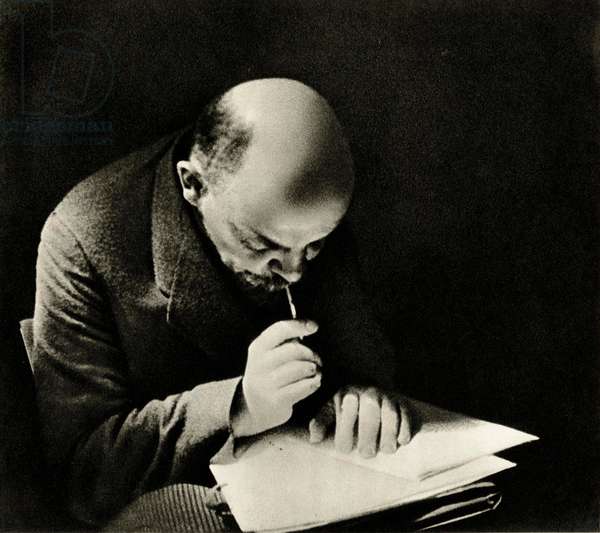
What’s the thumbnail? looks cool
“A manuscript from The German Ideology with Marx’s handwriting and Engels’ doodles, c. 1845-1846.”
from Wikipedia
Marx scribbling in The German Ideology.
I love using physics to explain and motivate dialectics.
Unity of opposites: magnets.
Quantity changing into quality: heating water.
Change resulting from struggle of opposite forces: Newton’s laws.
Dialectics is just how the world works!
Yep, it’s super intuitive for people raised on modern science this way. Math also helps, like addition and subtraction! They can each turn into their opposites as well, like adding or subtracting negatives.
It’s a bit funny that the most mysterious force on physics (it’s gravity lmao) doesn’t happen to have an opposite force. Maybe that’s why it’s so mysterious.
Thank you for this. 👍
No problem!
Just backing up a post I made on Lemmy.ml over here. Oversimplified and not a replacement for study.
Thank you. My issue is I tend to use literary device to translate “dangerous” ideas and vice-versa, should the danger from using the one way become the danger if using it the other. Plus they’re colorful and easy to scaffold on (and if I understand Strauss correctly, that’s what he was saying about eso- and exo- teric, and I agree and posted about it elsewhere. And those ideas are quickly becoming dangerous to espouse in plain terms again.
Example: as above, so below/on earth as it is in heaven: these are factually and metaphorically true, seen in the motions and behaviors of planets and stars to fractal patterns in flowers and pinecones, and what starts out in my noggin and is given attention and effort is what becomes manifest (given conducive conditions) in the material. It’s the point of The Vetruvian Man, arms and legs representing four basic elements, and the noggin representing the ethers. And da Vinci wasn’t born into wealth and luxury, he had wealthy patrons, and probably made sacrifices for his art we would find… unpalatable, today. I’m not arguing, but noting important points.
Also, in the balloon example, am I confused? Addition/subtraction are quantitative change?
Thanks Cowbee, helpful, as ever.
For the balloon, the quantitative change is an increase in air. The qualitative change is the pop. Addition and subtraction are both quantitative changes that result in qualitative leaps!
Got it, I was thinking you meant addition or subtraction of air in itself was qualitative, I see how I understood incorrectly. Thank you!
No problem!
thank you! i’m following your reading guide, and just finished reading Politzer’s “Elementary Principles of Philosophy”, so this will be a great way to strengthen my understanding of diamat!
Awesome! Out of curiosity, are you following this version of the basic guide, or the older one? I removed Politzer’s work due to introducing some flawed ideas of internal contradictions and autodynamism (despite being overall a great work). On Contradiction by Mao is enough to correct the misconceptions Politzer creates, so that’s really what I’m getting at.
Any thoughts on the guide so far?
oh, thanks for linking the updated guide! i’ll switch over to that one :) i wrote the list down back in january, so i do believe it’s the older version. that version does include On Practice and On Contradiction right afterwards though, so i was already about to start those later today
as someone who’s been following the reading order from the start, i think it does a fantastic job familiarizing the reader with the foundations of Marxism-Leninism. the way it moves from initial concepts to more complex ideas, all while dispelling common pitfalls and misunderstandings that might occur at first (ex. making clear that marxism is not simply “rich vs poor”), i found to be a very natural progression. plus, i never had any experience with reading any theory prior to this, so i’ve been pleasantly surprised at how accessible this guide has made it, even though some concepts like dialectical materialism do take a bit to get used to.
in short, i think your guide is great!! you clearly put a lot of thought and care into making sure it’s as comprehensive and accessible as possible, and it shows. thank you for all your work, comrade!
Thanks for the feedback! You can keep going or pivot to the new list, the new one is shorter and more condensed, IMO, so you’d probably finish it even if you started from scratch with it in a timelier manner. You’re free to do what you want, though, I still stand by the older list!
Good luck with the rest, and thanks for following it!
yeah, i think that might be a good idea; i was already considering starting from scratch once i saw new titles in previous sections, so having that reassurance of the new one being more condensed really sold me on the switch.
thank you for the suggestion!! :)
No problem! As always, please feel free to reach out with questions or suggestions!
Cowbee, by autodynamism you mean this part?
We see then that dialectical motion contains within itself processes or autodynamism, which is its essential feature. For not every motion or change is dialectical. […] Hence, [the act of crushing a flea] is not dialectical, but mechanical.
As far as I understand, Politzer’s mistake was claiming that “dialectics implies not only motion but also autodynamism”. However, as Mao said motion (even mechanical motion) necessarily needs contradictions to exist:
As a matter of fact, even mechanical motion under external force occurs through the internal contradictoriness of things. Simple growth in plants and animals, their quantitative development, is likewise chiefly the result of their internal contradictions.
Is this correct? Also thank you for your work comrade!
You’ve pretty much hit the nail on the head! Politzer’s flea example is wrong, and we can see examples from Mao that get it right:
Does materialist dialectics exclude external causes? Not at all. It holds that external causes are the condition of change and internal causes are the basis of change, and that external causes become operative through internal causes. In a suitable temperature an egg changes into a chicken, but no temperature can change a stone into a chicken, because each has a different basis. There is constant interaction between the peoples of different countries. In the era of capitalism, and especially in the era of imperialism and proletarian revolution, the interaction and mutual impact of different countries in the political, economic and cultural spheres are extremely great. The October Socialist Revolution ushered in a new epoch in world history as well as in Russian history. It exerted influence on internal changes in the other countries in the world and, similarly and in a particularly profound way, on internal changes in China. These changes, however, were effected through the inner laws of development of these countries, China included. In battle, one army is victorious and the other is defeated, both the victory and the defeat are determined by internal causes. The one is victorious either because it is strong or because of its competent generalship, the other is vanquished either because it is weak or because of its incompetent generalship; it is through internal causes that external causes become operative.
These mistakes ultimately hold Politzer’s view of change in general back to a vulgarization of dialectics. That’s why I suggested On Contradiction as an antidote to Politzer’s mistakes, as I really do love Politzer’s historic overview of philosophy. That’s also why I ultimately pitched Elementary Principles of Philosophy in favor of other, more correct works to hopefully prevent this mistake from taking root.
Mao’s example does make things clear. And yeah, it’s kind of sad that Politzer makes this mistake when his exposition on Idealism and Materialism is so good. No one is perfect, I suppose.
Thanks for the write-up!
No problem!
thank you so much! i was having a little difficulty understanding certaina spects, but this helped tremendously
No problem! The linked text by Cornforth is also really good, though to be warned that from time to time Cornforth follows the contemporary soviet line on genetics, following Lysenkoist views, and this is now known to be incorrect and a dogmatic use of dialectics. However, barring those few occasions, it’s an excellent work!