
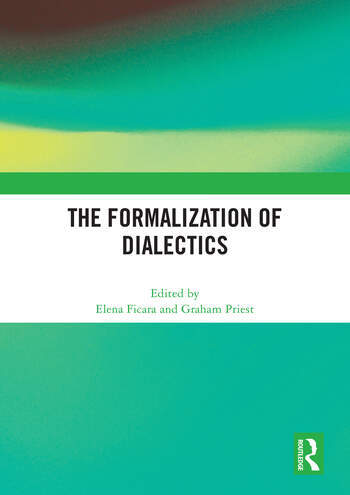
2023, Ficara E. & Priest G., The Formalization of Dialectics, 120 страниц, the print ISBNs are 9781032631660, 103263166X, Digital ISBN: 9781003813729, Publisher: Taylor and Francis
Cover
Half Title
Title Page
Copyright Page
Contents
Citation Information
Notes on Contributors
Introduction: The Formalization of Dialectics
References
1 Form, Formality, Formalism in Hegel’s Dialectic-Speculative Logic
1. Introduction
2. Logical Form and Formalization in Hegel’s Dialectic-Speculative Logic
2.1. ‘Thinking as Form’ and ‘Forms of Thinking’
2.2. Form and Content: Logical Form in General and Transcendental Logic
2.3. Dialectical Formality Against Formalism: Hegel’s ‘Absolute Form’
3. The Formality of Logical Form: Hegel’s Logic and the System of Philosophy
3.1. Logical and Real Forms
3.2. The Dialectic of Logical Form and the Project of Logical Formalization
References
2 Intuitionist and Classical Dimensions of Hegel’s Hybrid Logic
1. Introduction
2. The Pre-Analytic Russell, Hegel, and Geometry
3. Hegel, Geometry and Logic
4. Intuitionistic Logic’s Rejection of LEM as a Model for Hegel’s Logic.
5. Conclusion
ORCID
References
3 The Logical Structure of Dialectic
1. Introduction
2. Dialetheism
3. Outline of the Model
4. Applications: Hegel
5. Applications: Marx
6. Conclusion
References
Appendix. Technical Appendix
A.1 The Logic LP
A.2 The Dialectical Progression
4 Hegelian Conjunction, Hegelian Contradiction
1. Introduction
2. The Basic Proposal
3. A Formal Account
3.1. Models
3.2. Closure and Truth for Early Stages
3.3. Truth in a Model (or ‘In Reality’)
3.4. Hegelian Dialectical Entailment
4. Remarks on Some Formal Features
4.1. Simplification Fails
4.2. Explosion
4.3. Idempotence Fails
4.4. True Contradictions are Not Also False
5. Replies to a Few Objections
5.1. False Conjuncts!
5.2. Excluded Middle
5.3. Hegel's ‘Completion Principle’ is Clearly Pragmatic!
5.4. What of the Iterated Hegelian Process?
6. Closing Remarks
Acknowledgments
ORCID
References
5 Hegel’s Interpretation of the Sorites
1. Introduction
2. Hegel’s Sorites
2.1. Hegel’s Liar
2.2. The Sorites
2.3. The Logic and Metaphysics of the Sorites
2.3.1. Reflexion and Negation
2.3.2. The Einheit of Quality and Quantity
2.4. The EE and the Virtuous Progression of Reason
3. Hegel and the Contemporary Interpretations of Vagueness
3.1. How Tadpolefrogs Become Frogtadpoles
3.2. The Dialetheic Theory of Vagueness
4. Formalizing the EE?
4.1. The H-Conjunction
4.2. The Consequences
ORCID
References
6 Hegel’s Logic of Self-Predication
1. Introduction
2. The Question of Formality
3. Self-Predication and Existential Implication
4. Contradiction, Truth, and Modality
5. Illustrating the Concept: The Concept of Finitude
5.1. The Concept of Finitude
6. Hegel and the Square of Opposition
6.1. Hegel and the Traditional Square of Opposition
6.2. Hegel and the Modern Formalization of the Square of Opposition
7. The Formality of the Concept
7.1. The Abstract Concept
7.2. The Problem of Quantity
8. Conclusion: From Concept to Absolute Idea
References
7 A Lack of Form in Hegel’s Logic? Hegel and the Trans-classical Logic of Gotthard Günther
1. Introduction
2. The Opposition and Mediation of Being and Consciousness
2.1. The Logic of Being and the Logic of Consciousness
2.2. The Mediation of the Logic of Being and Consciousness
3. The Reflection of Reflection in Trans-classical Logic
4. Hegel Persists in Bivalence
5. A Different Form of Logic
5.1. The Changed Character of Logical Values
5.2. Polyvalence as Multiple Bivalence
6. Too Much Form in Hegel
References
Index
DOI:10.1080/01445340.2023.2182598
Graham Priest
Taylor & Francis Group — международное научное книжно-журнальное издательство со штаб-квартирой в Великобритании
http://philosophystorm.ru/edl-i-dialeteizm-grema-prista#comment-740944
ISBN: 9781003813729
This book explores the relationship between Hegel’s dialectics and formal logic. It examines the concept of dialectics, its meaning, and its use in contemporary thought. The volume opens the “old” debate about the formalization of Hegel’s dialectics and is motivated by the idea that asking about the connection between Hegel’s dialectics and formal logic is still relevant, for various reasons: Firstly, a new Hegel is circulating nowadays in the philosophical literature, with specific reference to Hegel’s dialectical logic and its relation to the history and philosophy of logic. Secondly, new research about the connection between contradictory logical systems and Hegel’s dialectics is also being developed. Finally, there have been recent confirmations that the concept of dialectics is of general interest, and that the usual perplexities about the Hegelian triadic and fairly mechanic device of ‘yes, not, and not not’ are in remission. The chapters feature philosophically and historically motivated presentations of formal features of Hegel’s dialectics, critical considerations about the very idea of ‘formalizing dialectics’ and presentations of past attempts to formalize Hegel’s dialectics. The Formalization of Dialectics will be a key resource for scholars and researchers of the history and philosophy of logic and Hegel’s dialectics. It will also be of interest to anyone who wants to know more about the concept of dialectics, its meaning and its use in contemporary thought. This book was originally published as a special issue of History and Philosophy of Logic.
Эта книга исследует взаимосвязь между диалектикой Гегеля и формальной логикой. В ней рассматривается концепция диалектики, её значение и использование в современной мысли. Том открывает «старую» дискуссию о формализации диалектики Гегеля и мотивирован идеей о том, что вопрос о связи между диалектикой Гегеля и формальной логикой по-прежнему актуален по нескольким причинам: во-первых, в философской литературе сегодня циркулирует новый Гегель, в частности, с акцентом на диалектическую логику Гегеля и её связь с историей и философией логики. Во-вторых, также ведутся новые исследования связи между противоречивыми логическими системами и диалектикой Гегеля. Наконец, в последнее время появились подтверждения того, что концепция диалектики представляет общий интерес, и что обычные затруднения, связанные с гегелевским триадическим и довольно механическим устройством «да, нет и не нет», утихли. В главах представлены философски и исторически обоснованные изложения формальных особенностей диалектики Гегеля, критические размышления о самой идее «формализации диалектики» и обзоры прошлых попыток формализации диалектики Гегеля. «Формализация диалектики» станет ключевым ресурсом для ученых и исследователей истории и философии логики и диалектики Гегеля. Она также будет интересна всем, кто хочет узнать больше о концепции диалектики, ее значении и использовании в современной мысли. Эта книга первоначально была опубликована как специальный выпуск журнала «История и философия логики».